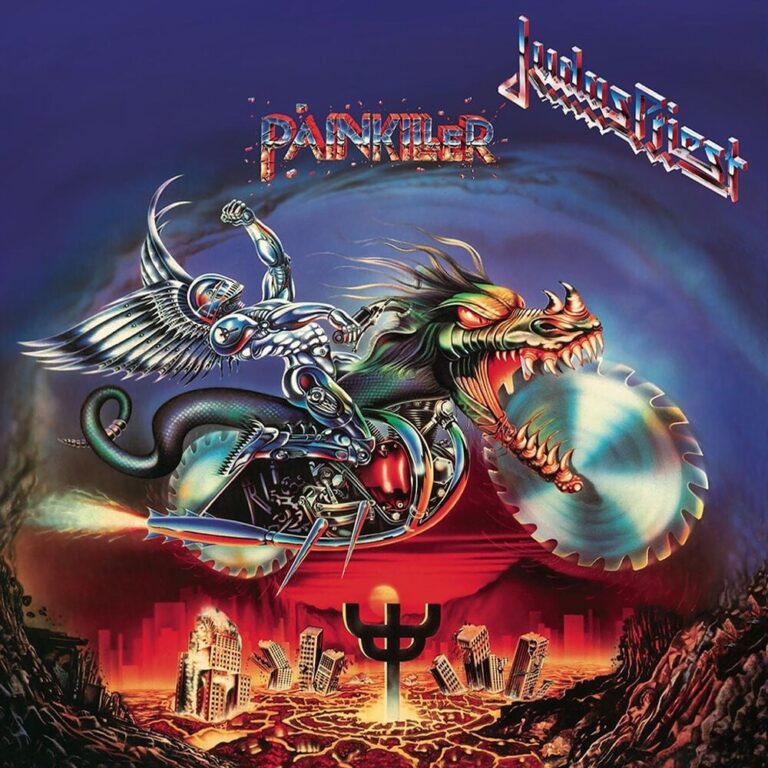
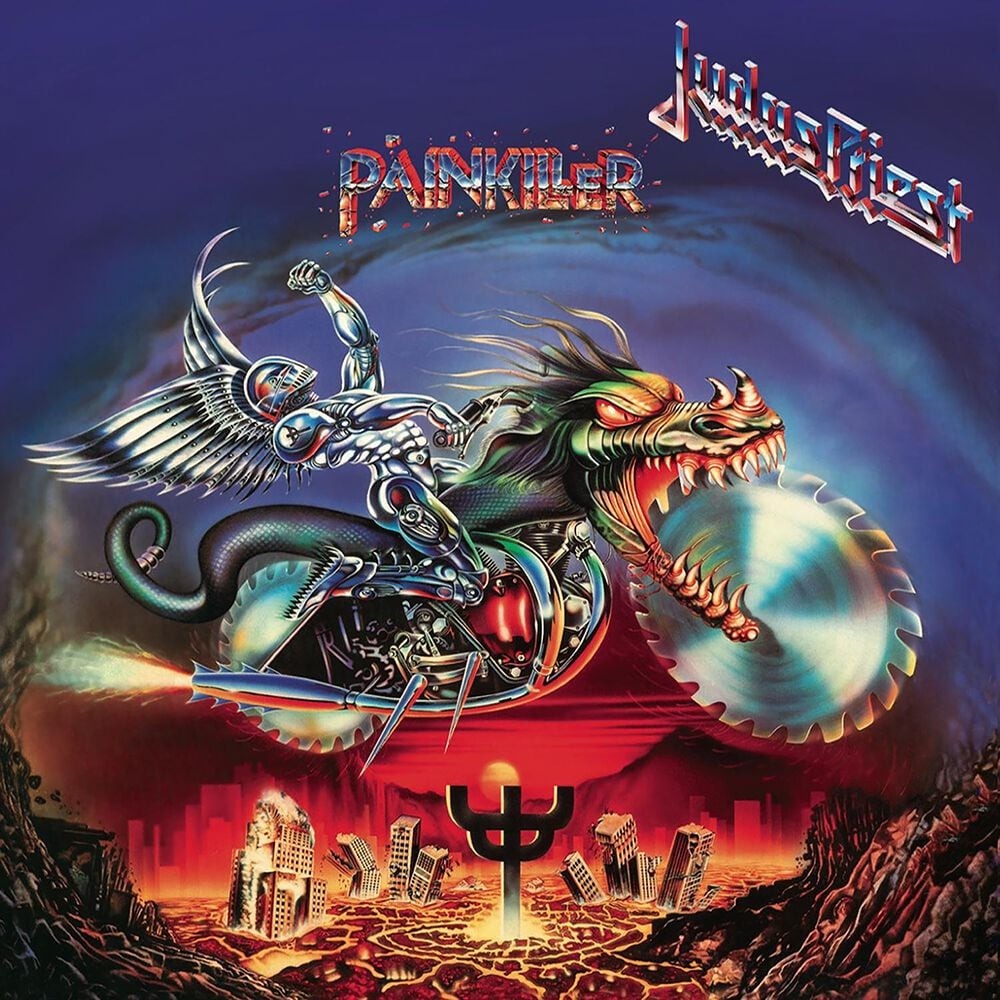
When Judas Priest released “Painkiller”, I was only thirteen, and I only had partial knowledge of Judas Priest’s already extensive catalogue. The reason for that was, naturally, my young age – and the fact that back then you still had to either buy the album or copy it onto a cassette from a friend. The record I knew best from Judas Priest was “Turbo”, which had come out four years earlier, mostly because my childhood mate Jostein Kiviniemi had it on cassette and played it a lot. His favourite band was Judas Priest, while mine was Iron Maiden. So when I managed to buy “Painkiller” brand new and put it on, it knocked me backwards. Since I hadn’t yet heard “Ram It Down”, the musical leap from “Turbo” to “Painkiller” felt enormous. “Turbo” is, after all, the Judas Priest album with the softest sound after their debut.
The opening of “Painkiller” – with that legendary drum intro and Rob Halford’s fiercest scream – was like a kick in the nuts. So much so that you almost felt like you could hit the same heights in your own vocal range as Halford. Almost. The high tempo, the aggressive riffs, the duelling guitar solos, Halford’s screams, and those razor-sharp melodies were like a mecca for true heavy metal. I actually think it was almost too much of a good thing for Priest fan Jostein at first, but I was pretty quickly swallowed up by the sheer force of “Painkiller”. I remember having to open the windows because it was so fantastic that the neighbourhood had to hear just how incredible Judas Priest’s new album sounded. Even though Bugøynes isn’t exactly a warm place in autumn. But that didn’t matter – what mattered was that music this good had to be shared.
The strange thing about Judas Priest is that even though they’re pioneers of heavy metal, they’ve always had a knack for turning with the wind. In 1980 they adopted the NWOBHM sound on “British Steel”; in 1986 they went for permanent-style sheen and synth guitars on “Turbo” – because hair metal was in vogue. Later, they even flirted with a groove metal sound on “Jugulator”. But in 1990, thrash metal was the big thing, and you can hear it on “Painkiller”. There isn’t a single weak moment on “Painkiller”. From the title track to the more melodic “Night Crawler”, and on to the epic “A Touch of Evil” and “One Shot at Glory”, “Painkiller” is a masterpiece and, to this day, one of my absolute favourite albums. If I were to rank Judas Priest’s albums, “Painkiller” sits at the top – even if it’s a close race. This is the very blueprint for heavy metal.
Released September 3rd, 1990 on Columbia Records.
About The Author